Most-historical Apparatus : “AI” and the Crisis of Linearity
This paper analyzes machine learning-based services such as LLMs and AI-image generation through Vilém Flusser's account of linearity, causality, and rationality as historically specific cultural techniques. It argues that these technological applications do not suspend linear thinking but operationalize it at scale through ramified, sequential procedures that remain strictly causal. The apparent non-linearity of probabilistic generation of media artifacts such as text, image and video belongs to the level of experience, not to the functioning of the apparatus. Rationality persists within these technological media as program. The contemporary crisis of rationality is therefore not its disappearance but its withdrawal from conscious critique into automated systems controlled by institutional power. The paper argues that the foundational democratic intuitions which emerged with the development of linear writing and linear rationality have been historically constrained by extra-rational exercise of power. Only through the radical democratisation of that power can the emancipatory potential promised of hyper-rational so-called “AI" be realized.
Über den menschlichen Kopf als archivische Form
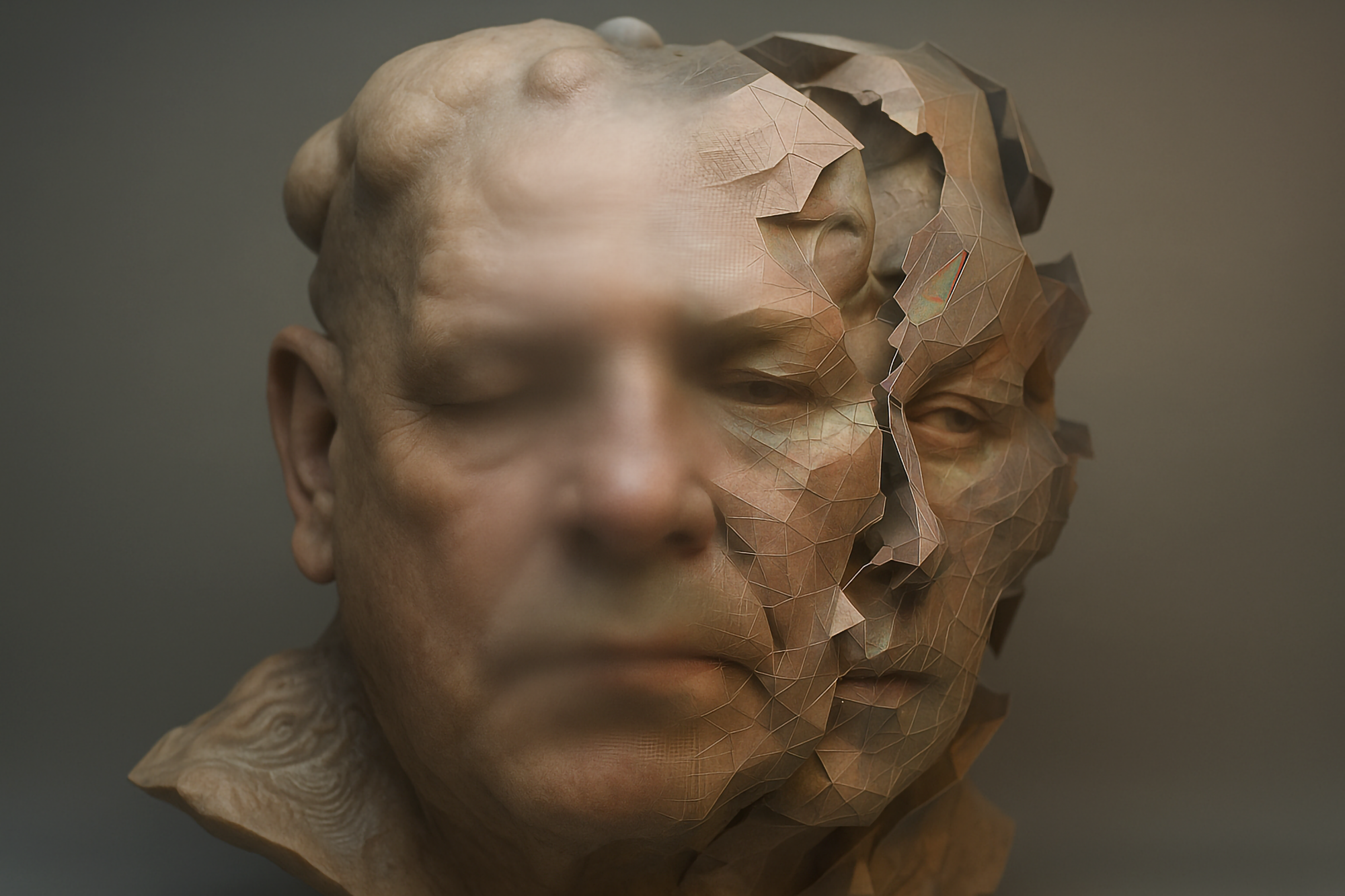
The series examines the human head as an archival structure operating at the threshold between representation and material register. Although the images maintain the frontal conventions of portraiture, they suspend its expressive and identificatory functions. The head is treated as a site of accumulation: organic matter, time, and algorithmic processes converge on its surface without hierarchy or narrative orientation. The eyes remain closed, gestures are neutralized, and variation is minimized. Created through a controlled interaction of digital modeling, image synthesis, and procedural iteration, the works operate as a closed system in which difference emerges slowly and cumulatively. Rather than asserting individuality, the series constructs a state of persistence in which the body appears as a storage medium subject to compression, erosion, and long-term transformation.


Cybernetic Memories: Flusser’s Apparatus in the Age of Artificial Intelligence
This essay revisits Vilém Flusser’s concept of cybernetic memories to examine artificial intelligence as a terminal stage of the Apparatus, where predictive archives risk foreclosing the event of memory itself. Through dialogue with Bernard Stiegler, Jacques Derrida, Frédéric Neyrat, and Gilbert Simondon, it distinguishes memory as storage from memory as embodied impression, arguing that forgetting, abstraction, and rupture are conditions of learning and individuation. Against predictive temporality, the essay proposes prophetic survival, dialogical cybernetics, and the mechanologist as figures for preserving mental integrity, techno-intersubjectivity, and the human capacity for deep memory within AI-mediated technical systems.
Humanization of Objects and Objectification of Humans. Vilém Flusser’s Philosophy of Apparatus and AI
This article examines two major trends in human civilization, namely the humanization of objects and the objectification of humans, through the media philosophy of Vilém Flusser. Here, objects broadly refer to all human-made items, but primarily indicate means of production (tools, machines, apparatus) in a narrower sense. Specifically, this article traces the historical tendency of objects increasingly resembling the human body and brain since the advent of humanity, and conversely, humans progressively resembling the objects they create. Among these tendencies, it particularly analyzes in detail the trends of the artificial intelligence era driven by apparatus: the intelligentization of objects and the robotization of humans. As specific examples for this analysis, the article presents photographic apparatus as the first apparatus, and apparatus-humans (photographers and spectators, all of us). Through this, the article aims to uncover the fundamental meanings of recently emerging academic paradigms such as artificial intelligence and robot, and reveal the deep-seated causes underlying contemporary human robotization.
Ficção Filosófica e Perspectivismo Ameríndio: Diálogos conceituais entre Vilém Flusser e Eduardo Viveiros de Castro
Based on the theoretical contribution of Vilém Flusser to the themes of identity and identification, this article approximates Flusserian thought and the Amerindian perspectivism of the Brazilian anthropologist Eduardo Viveiro de Castro. It argues, on the basis of the book Vampyroteuthis Infernalis, that Flusser performs an exercise in perspectivism, as he proposes an imaginative experience allowing readers to adopt the point of view of another nonhuman being, in this case, the octopus.