Über den menschlichen Kopf als archivische Form
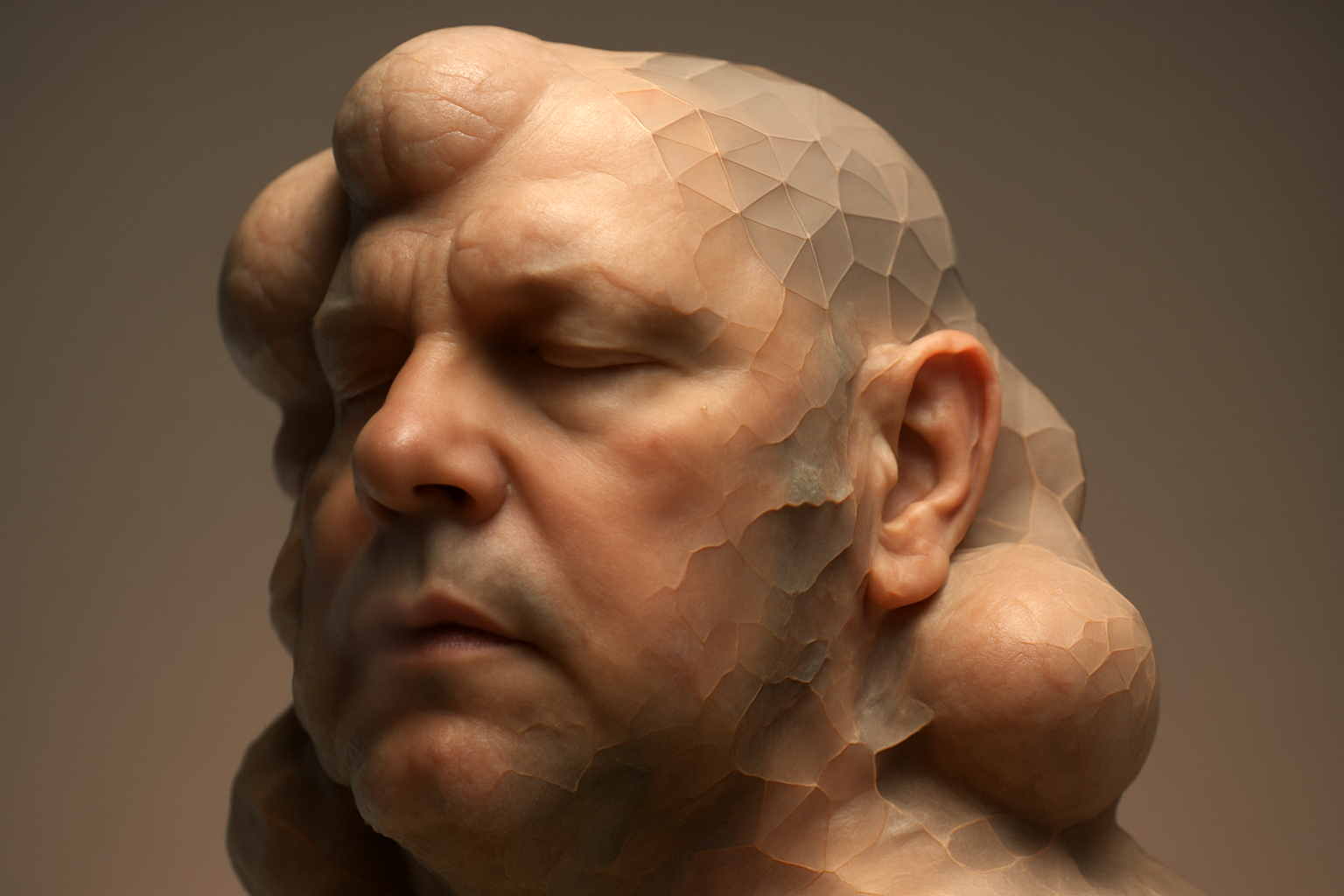
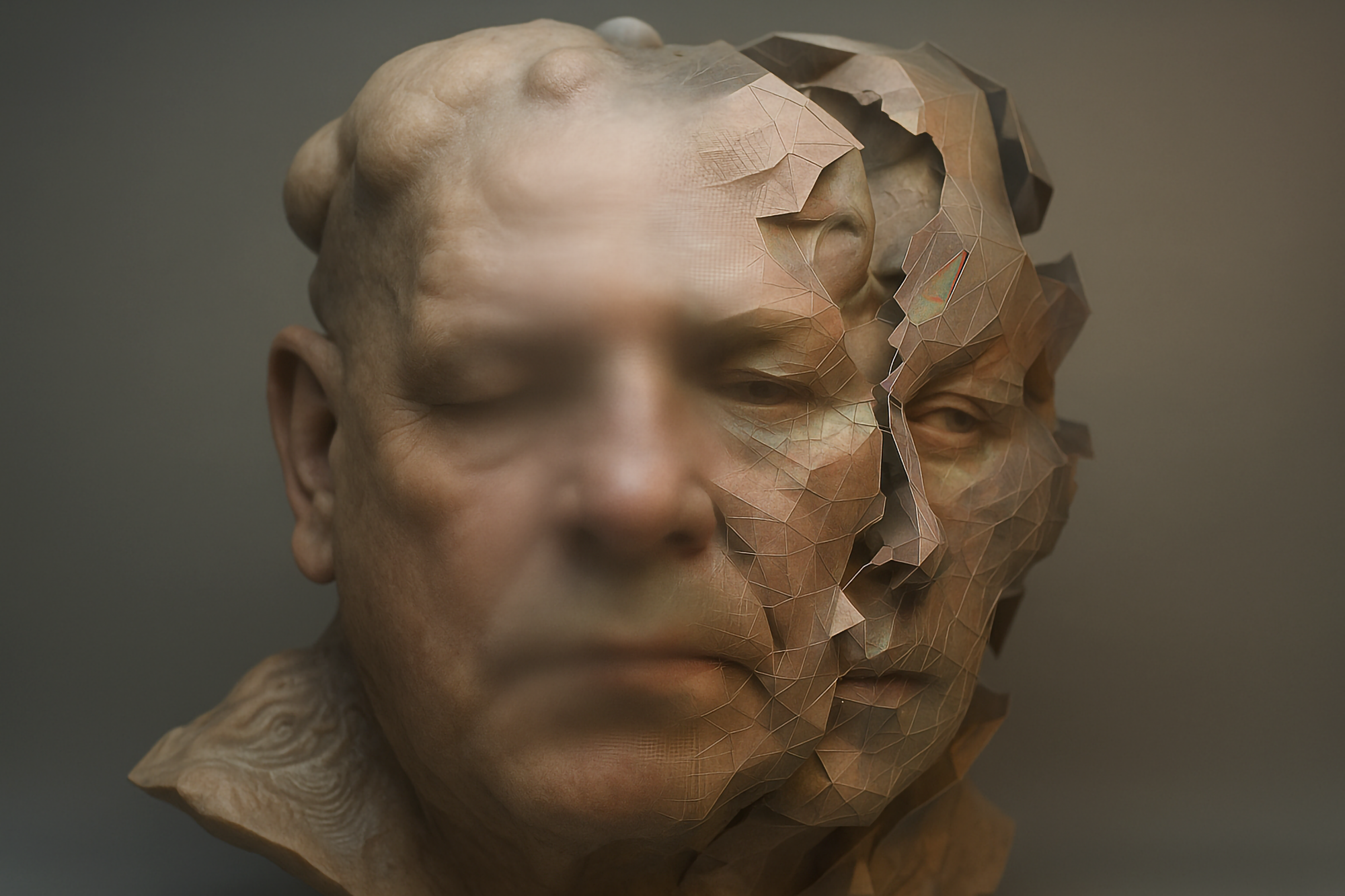
The series examines the human head as an archival structure operating at the threshold between representation and material register. Although the images maintain the frontal conventions of portraiture, they suspend its expressive and identificatory functions. The head is treated as a site of accumulation: organic matter, time, and algorithmic processes converge on its surface without hierarchy or narrative orientation. The eyes remain closed, gestures are neutralized, and variation is minimized. Created through a controlled interaction of digital modeling, image synthesis, and procedural iteration, the works operate as a closed system in which difference emerges slowly and cumulatively. Rather than asserting individuality, the series constructs a state of persistence in which the body appears as a storage medium subject to compression, erosion, and long-term transformation.

The Generative AI Factory
This article examines generative artificial intelligence not as a disembodied, cloud based phenomenon, but as a planetary factory. It is a vast and material infrastructure rooted in geological extraction, logistical networks, and asymmetrical labor relations. Drawing on Vilém Flusser's premise that to decipher an era one must decode its factories, the analysis traces the production chain of contemporary AI across multiple sites. These include rare earth mining, semiconductor manufacturing, data centers, submarine cables, surveillance systems, and space colonization. The text also presents the art pieces of Trevor Paglen and Elisa Giardina Papa to shed light on two crucial matters: how humans are being trained by AI systems, and what invisible infrastructures support the entire edifice. Beneath what appears as immediate and seamless mediation lies a complex metabolic process of ingestion, digestion, excretion, and re-ingestion of data. This is a logic that Kate Crawford terms the "metabolic image." The article concludes that the AI factory is not an inescapable fate. Rather, it is the crystallization of specific political and economic choices. Demystifying its material and operational logic is a necessary condition for reclaiming human agency, imagining alternative futures, and reopening the apertures that, in Flusser's warning, are rapidly closing off.
Experiencing Programmed Magic: AI Image Generation and the Photo-Roman
This research does not aim to define artificial intelligence theoretically, nor does it seek to provide a systematic exposition of Vilém Flusser’s thought. Instead, it begins from the question of how vision has come to define space in architecture and examines, through practice, the conditions under which technical images operate within processes of AI-based image generation. Writing not as a Flusser scholar but as an architect, the author seeks to unsettle the assumptions through which visually centered conceptions of space have been naturalized via perspective, photography, and digital media. Within this context, the text takes the form of a working report that documents the experience of what Flusser described as the “programmed magic” of technical images as it emerged during the production of an eleven-minute photo-roman. The case study, a photo-roman titled Eyes of Epoché, is a fictional project inspired by philosophical thought experiments concerning perception and knowledge. By depicting a subject who has perceived the world exclusively through vision and remains unable to intuitively comprehend spatial relationships even after regaining bodily movement, the work exposes vision not as a natural or universal faculty but as a system constructed through specific conditions and forms of learning. The production process, which moved from collage-based storyboards to AI-generated images, reveals a gradual shift in authorship from the act of designing images toward the adjustment and selection of possibilities provided by a generative program. This research approaches AI-based image generation as a form of technical imagery continuous with photography, arguing that their primary difference lies not in representational outcomes but in the speed and manner through which uncertainty and failure are resolved. In doing so, it raises the question of whether the possibility of artistic play, as articulated by Flusser, can still be established in relation to this emerging apparatus.
Versuchsreihe zur Auslotung ästhetischer Möglichkeiten K.I.-generierender Mittel in bildgebenden Verfahren anhand von „Rotkäppchen“
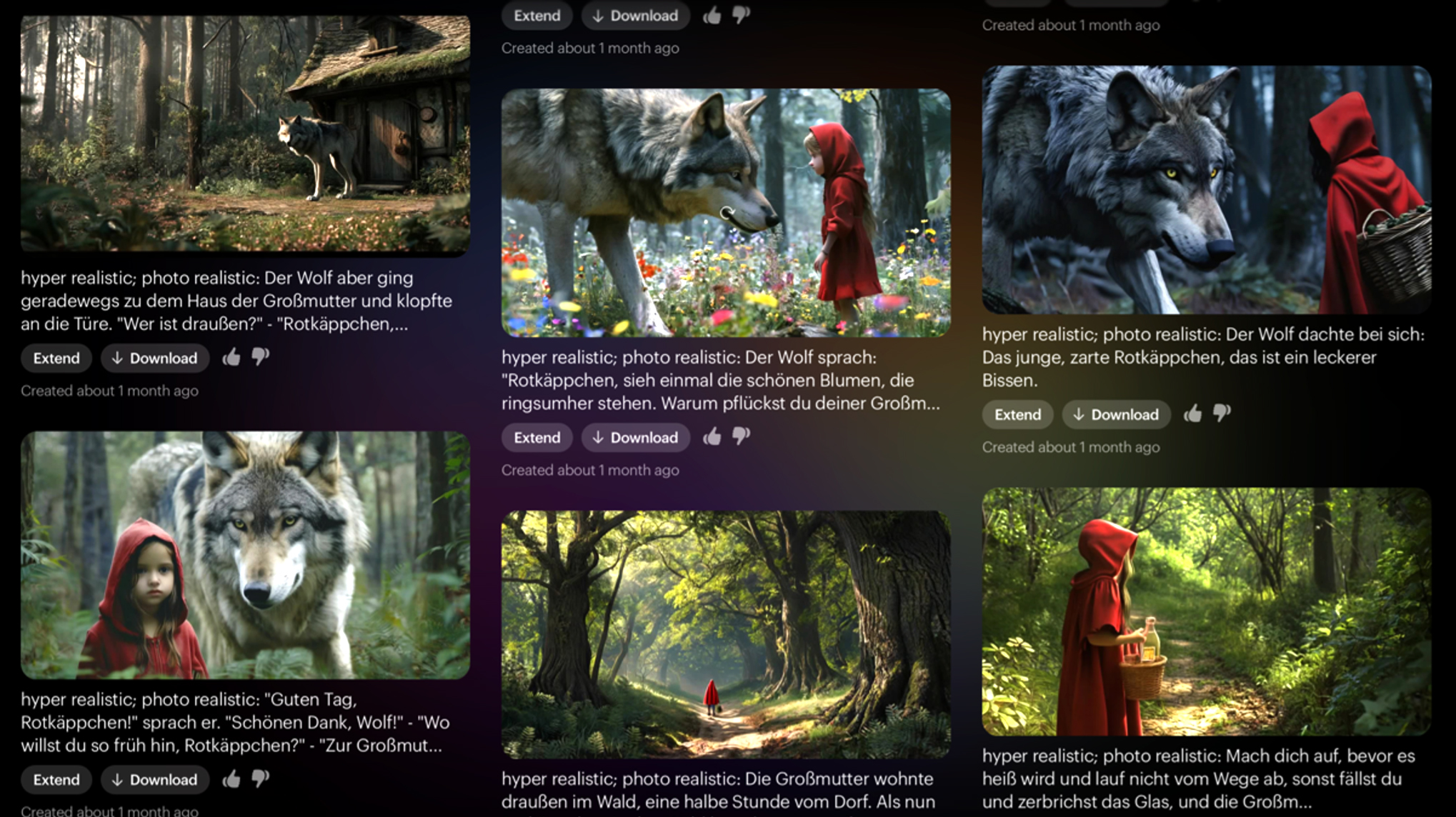
As early as the 1980s, Vilém Flusser described the transition from writing culture to image culture, in which technological images displace texts. This prediction is coming true today, as images disguised as data packets are decisively shaping our actions. They increasingly originate from AI-based image generators that translate language into synthetic images in highly complex, latent spaces, thus re-ordering the relationship between text and image. The artistic experiment titled Rotkäppchen (Little Red Riding Hood) was created by “feeding” AI with original prose sequences of the Grimm Brothers and editing the resulting sequences into a film. The project sheds light on the machine-based translation of language into pictures, and understands itself as critically distanced “art about AI” that, in the sense of Flusser, addresses the functioning and power logics of the apparatuses.


Vilém Flusser's Media Philosophy of Artificial Intelligence
In his philosophy of media, Vilém Flusser offers profound insights into the transition of human communication from a “writing civilization” to a “programmed civilization” through key concepts such as “programmed thinking,” the “apparatus,” and “artificial intelligence.” He argues that the linear, historical, and critical characteristics of traditional writing are being replaced by the programmed and functional logic of symbolic encoding. Among these, the “apparatus” serves as the operational matrix of programmed thinking, devouring history to generate post-history (technical images) and transforming humans into “functionaries,” ultimately diluting human subjectivity. Artificial intelligence, as a programmed apparatus, further intensifies this crisis by projecting and simulating human brain functions externally. Based on this, this paper examines the internal logic among Flusser’s concepts of programmed thinking, the apparatus, and artificial intelligence, synthesizes the theoretical framework of his thought on artificial intelligence as media, and provides theoretical resources for understanding the technological‑cultural dilemmas of the digital age. Furthermore, through a phenomenological‑existential “secondary translation,” this paper reframes the crisis of subjectivity as a generative issue within media ontology, offering a theoretical entry point for revisiting human subjectivity in the digital era.
Phenomenological crossroads between Husserl and Flusser. Toward a Phenomenology of the Image in the post-digital age of AI
This article examines the phenomenological relationship between Edmund Husserl’s foundational ideas on intentionality, perception, and consciousness, and Vilém Flusser’s media-philosophical critique of technical images. While Husserl laid the groundwork for understanding consciousness as always directed toward objects through intentional acts, Flusser extended this logic to consider how new media—specifically technical images—restructure the horizon of intentional experience. Through a comparative reading, we argue that Flusser offers a post-phenomenological extension of Husserlian thought, addressing the historical evolution of appearance and its mediation through apparatuses. By situating technical images within the lifeworld (Lebenswelt), the article shows how Flusser’s theory can be understood as a phenomenology of post-industrial perception, where the image no longer reveals the world, but instead simulates it, altering the structure of intentionality itself. Ultimately, we propose a synthesis that sees Flusser’s technical image not merely as a cultural artifact but as a new noematic layer within phenomenological experience, calling for a reconsideration of subjectivity and meaning in the digital age.
Medienphilosophie als „Kommunikologie” – Vilém Flussers (1920-1991) Phänomenologie des Medialen
Despite his ambivalence towards the concept of “media”, Vilém Flusser is considered one of the foundational figures of media philosophy. His complex and associative thinking is highly sceptical with regard to traditional science-orientated media concepts. Flusser’s unique approach to media theory is fundamentally a phenomenology of the media. To capture these tensions the essay pursues a work-inherent interpretation. The essay delves into Flusser’s “Communicology” focusing on his ideas about texts, codes, symbols, and the interplay between media and human thought. One main thesis of the paper is that Flusser emphasizes in his work the need for a nuanced understanding of media philosophy, considering diverse methodological approaches and the evolving nature of media in contemporary society.
Dans l’univers des images techniques – en VF
Although a growing number of Vilém Flusser’s texts have been made available in France, where he spent the last part of his life, the decisive book Ins Universum der technischen Bilder, from 1985, is still missing. Written two years after Für eine Philosophie der Fotografie, his most influential book -- translated into French in 1996, Ins Universum der technischen Bilder is arguably one of Flusser’s theoretically most ambitious books. It aims to describe the entire history of visualization techniques. Both foreshadowing the development of digitization processes to come and harking back to the earliest moments of civilization, this book will make the full potential of the thought-provoking ideas already available in French more readily understandable than they were at the time of their publication. This French translation by Pierre Rusch will facilitate a new understanding of this crucial phase in Flusser’s oeuvre, where the insights into the automated character of the photographic images are taken to the level of a phenomenology of technical gestures, with “abstracting” and “concretizing” as their key operations.
Die Dimension der Leere. Vedanta und Buddhismus in Vilém Flussers Das Zwanzigste Jahrhundert und Bodenlos
This short essay explores some of the connections between Vilém Flusser’s study of eastern philosophy in the 1940s and 1950s and his later notion of zero dimensionality. In his first book, Das Zwanzigste Jahrhundert, he pointed to a theoretical convergence between the Indian Vedanta, Buddhism and modern natural sciences. In his autobiography, Bodenlos, written in the early 1970s Flusser reevaluated his former interest in oriental philosophy in highly critical terms. However, despite this attempt at distancing, some of the notions from Das Zwanzigste Jahrhundert infiltrated his late vision of an emerging universe of technical images.
Flusser, Media Theory and I. From the Genealogy of Thought
This essay is a case study of a coincidence both in terms of a personal perspective of the author’s encounter with Vilém Flusser’s philosophical and theoretical thought, and with regard to notions of necessity, destiny, and fate. In the present essay, this type of randomness is called ‘primordial accidentalism’. The author discusses his experiences in applying Flusser’s concepts of apparatus, alphanumeric society and technical images, to the creation of concepts referring to digital photography, new media, new media art, cyber-culture and techno-culture. Moreover, the author recalls his experiences with the two Polish editions of Towards a Philosophy of Photography (2004 and 2015), which undoubtedly contributed to the popularization of Flusser’s philosophical concepts among artists, media theorists and philosophers.